

A long journey changes the way you think about transport. For a short trip across town, most people simply need a taxi at the right time. A longer journey brings more questions. How much luggage is there? Can everyone travel together? How early should the journey start? Is the car large enough? Would a train involve several changes? And what happens when the event, meeting or flight is over and it is time to come home?
These details matter more than the number of miles on the map. A long distance taxi service can make sense for airport journeys, business travel, family trips, weddings, events and journeys between towns or cities. The advantage is straightforward: one vehicle, one planned journey and no need to change halfway through.
When Does a Taxi Journey Become Long Distance?
There is no official distance that turns an ordinary taxi journey into a long-distance one. A journey from one town to another might feel long to one passenger and completely routine to another. The more useful measure is what the journey involves.

For example, a longer taxi journey might take you:
- From your home to an airport
- Between two towns or cities
- To a wedding venue
- To a business meeting
- To a sporting or entertainment event
- To a railway station for onward travel
- Across Kent or into another part of the UK
- To a destination where public transport involves several changes
The practical difference is that a longer journey deserves more planning. A few minutes spent checking the route, vehicle and luggage requirements can prevent problems later.
When Does Taking a Taxi Make Sense?
A taxi is not automatically the right choice for every long journey. Trains, coaches and driving yourself can all work well depending on the route. A taxi becomes more attractive when the convenience of travelling directly matters.
Travelling door to door
There is no need to make your way to a station first or arrange another vehicle at the other end.
That can be especially useful with luggage or for passengers travelling from a residential address.
Travelling with several people
A group can travel together rather than organising separate transport or coordinating different public transport journeys.
Working around a specific timetable
A flight, wedding ceremony, business meeting or event may dictate when you need to arrive. A pre-arranged taxi can be planned around that schedule.
Avoiding multiple connections
A train journey may involve one or more changes. That is manageable for many travellers, but becomes less appealing when several people are carrying luggage.
Reaching less convenient destinations
Some venues, rural addresses and business locations are easier to reach by road than by public transport.
The best option depends on the complete journey, not simply the distance.
What Should You Check Before Booking a Long Distance Taxi?
The longer the journey, the more worthwhile it is to get the details right before the booking is made.
Start with the exact route
A town name is not always enough.
Give the full pickup address and destination, particularly for hotels, venues, business premises, airports and large buildings.
This helps avoid confusion about where the journey starts and finishes.
Count the passengers
The number of passengers determines which vehicles can be considered.
But passenger capacity is only half the equation.
Think about the luggage too
Four passengers with four small bags is very different from four passengers with several large suitcases.
Before booking, consider:
- Large suitcases
- Smaller bags
- Hand luggage
- Children’s luggage
- Bulky items
- Any equipment being carried
This is one reason it is useful to discuss the complete journey rather than simply saying, “There are four of us.”
Think about the timing
A long journey should not be planned around the shortest possible driving time.
Traffic and road conditions can change the actual journey considerably. A little extra planning becomes even more important when the destination is an airport, wedding venue, business meeting or event.
Choosing the Right Vehicle for a Long Journey
Vehicle choice matters more on a long trip because passengers will spend considerably more time inside it. A vehicle needs to work for the whole group, including the luggage.
For example, Vine Taxis currently lists:
- Toyota Prius — up to 4 passengers
- Mercedes E-Class — up to 4 passengers
- Tesla Model Y — up to 4 passengers
- MPV — approximately 5–6 passengers
- Mercedes Vito — approximately 7–8 passengers
The most suitable option depends on the number of passengers and the amount of luggage involved. A larger vehicle can make sense for a group, while a smaller vehicle may be perfectly adequate for one or two passengers travelling with limited luggage.
There is little value in choosing a vehicle based purely on its seating capacity and discovering later that the luggage takes up more room than expected.
Long Distance Taxi Travel With Luggage
Luggage is easy to underestimate. A weekend bag for one passenger is straightforward. Airport luggage for a family is another matter entirely. Before the journey, count the bags rather than making a rough assumption about them.
This is particularly important for:
- Airport journeys
- Family holidays
- Wedding travel
- Group trips
- Business travel involving equipment
- Longer stays away from home
The same principle applies to the return journey. A group may leave home with relatively little luggage and return with considerably more.
Providing the luggage details when arranging the taxi gives the operator a much clearer picture of the vehicle required.
Long Distance Airport Journeys

Airport travel is one of the clearest examples of where journey planning matters. Suppose a flight leaves in the morning. The taxi is only the first part of the schedule. There is also the drive to the airport, terminal arrival, check-in, baggage drop, security and boarding. That means the sensible starting point is the required airport arrival time, not simply the flight departure time.
Vine Taxis provides airport journeys to Gatwick, Heathrow, London City, Luton and Stansted.
For a longer airport journey, consider:
- The flight departure time
- The airport’s recommended arrival time
- Check-in and baggage requirements
- Number of passengers
- Number of bags
- Pickup location
- Expected road travel time
What About Families Travelling Long Distance?
A long car journey with children requires a little more thought than travelling alone.
The basic questions remain simple:
How many people are travelling?
How much luggage are they bringing?
Does everyone need to travel together?
How much time does the journey realistically need?
A family travelling to an airport might need more luggage space than the passenger count initially suggests. A family travelling to a wedding might also need to think about the return journey and where the taxi should collect them afterwards.
Planning those details beforehand is much easier than trying to work them out on the day.
Long Distance Taxi Travel for Groups
Group journeys often look simple on paper.
Six people need to get from A to B.
Then the details appear.
Someone has two suitcases. Another passenger needs to collect from a different address. The event finishes later than expected. The return journey starts from somewhere different from the original destination. That is why group travel benefits from a proper plan.
Before booking, establish:
- How many people are travelling
- Where everyone needs collecting
- How much luggage the group has
- Whether one vehicle can accommodate everyone
- Where the return journey will begin
- Whether the group needs to travel together
Long Distance Taxi Travel for Business
Business journeys have a different priority: time and coordination. A long-distance business trip might involve a client meeting, an airport, a conference, several appointments or travel between different business locations. A direct road journey can remove some of the changes and connections involved in public transport.
It also means the journey can be planned around the working day rather than fitting everything around a train timetable. We also provide corporate transfers for business-related journeys, so the main focus here can remain on the wider question of planning long-distance travel.
Weddings, Events and Longer Journeys
Wedding and event travel can involve several separate journeys rather than one simple trip.
A typical wedding might involve:
Home → hotel → ceremony → reception → hotel
Guests may also arrive from different towns and need transport at different times.
The same issue appears with concerts, sporting events, parties and other occasions.
A little planning beforehand can answer the important questions:
- Where are guests staying?
- Where is the venue?
- How many passengers need transport?
- Does anyone have luggage?
- When does the event finish?
- Where should the return journey start?
How to Compare Long Distance Taxi Services
Searching for the best long distance taxi service in the UK can produce plenty of results, but there is no universal answer. A better approach is to compare the things that actually affect your journey.
Does the provider cover your route?
A taxi company can be excellent locally but unsuitable for a particular destination.
Is there a suitable vehicle?
Check both passenger capacity and luggage requirements.
Can the journey details be communicated clearly?
Long journeys involve more information than a quick local trip.
Does the service fit your schedule?
Airport departures, weddings and business appointments all require careful timing.
Does the provider handle the type of journey you need?
A company regularly handling airport, event, group and business travel may have different practical experience from one focused solely on short local journeys.
Long Distance Taxi or Train?
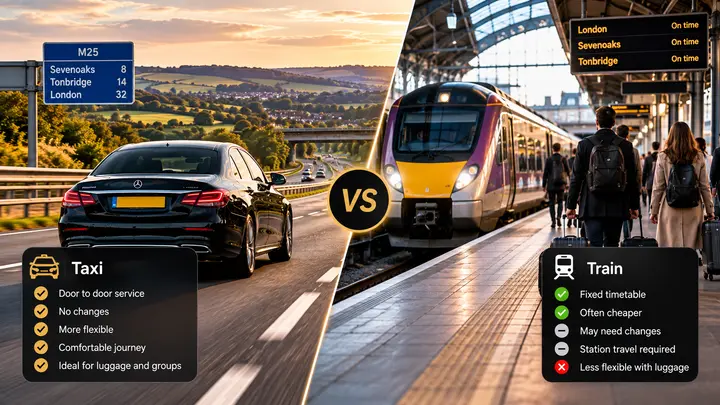
Both can be good options. The route and circumstances should decide the choice.
| Consideration | Taxi | Train |
| Starting point | Can begin at the agreed pickup address | Usually requires getting to a station |
| Final destination | Direct to the agreed destination | May require onward travel |
| Connections | No changes during the taxi journey | Connections may be necessary |
| Departure time | Arranged around the journey | Based on the timetable |
| Group travel | Depends on vehicle capacity | Depends on available services |
| Luggage | Vehicle space needs consideration | Passenger and operator arrangements apply |
| Door-to-door travel | Yes | Usually requires additional travel |
For a solo traveller between well-connected city centres, a train may be the obvious option. For a family carrying several bags to an airport, or a group travelling to a venue outside a town centre, the convenience of a direct taxi may matter more.
How to Plan a Long Taxi Journey
Before making a booking, write down five things:
1. Where are you starting?
Use the full pickup address.
2. Where are you going?
Include the complete destination or terminal.
3. Who is travelling?
Give the exact passenger number.
4. What are you taking with you?
Mention suitcases, bags and anything unusually large.
5. When do you need to arrive?
Work backwards from the important arrival time rather than simply choosing the earliest convenient pickup.
For return journeys, make the same plan for the trip home. This takes only a few minutes and gives the taxi provider the information needed to discuss the journey properly.
A Practical Checklist Before You Travel
Before the day arrives, check:
- Pickup address is correct
- Destination is correct
- Date is correct
- Pickup time is confirmed
- Passenger number is accurate
- Luggage has been considered
- Vehicle size suits the group
- Important arrival deadlines have been allowed for
- Return arrangements have been considered
- Contact details are available
For a long journey, these basics matter far more than filling the booking with unnecessary detail.
Planning a Longer Journey?
A long-distance journey does not need complicated planning. Start with the basics: the route, passengers, luggage and the time you need to arrive. From Sevenoaks and surrounding Kent areas, Vine Taxis handles a range of longer journeys alongside airport, business, wedding and event travel. For a specific journey, the most useful information to provide is where you’re travelling from, where you’re going, how many people are travelling and how much luggage you’re taking.
Frequently Asked Questions
Can I book a long distance taxi in the UK?
Long-distance taxi journeys can be arranged for airport travel, business trips, family journeys, weddings, events and travel between different towns or cities. The route, passenger numbers and vehicle requirements should be provided when arranging the journey.
How do I choose the right vehicle for a long journey?
Start with the number of passengers, then consider luggage. Four passengers with limited luggage may have very different requirements from four passengers travelling with several large suitcases.
Is a long-distance taxi suitable for airport travel?
A direct taxi can be a practical option for airport travel, particularly when passengers have luggage or the journey involves an early departure. The flight schedule, airport arrival requirements and road travel time all need to be considered.
Can a group travel together?
That depends on the size of the group and the available vehicle. Larger vehicle options can accommodate more passengers, but luggage requirements should also be considered before booking.
Should I arrange the return journey at the same time?
For weddings, events, business trips and planned visits, considering the return journey at the beginning can make the overall travel arrangement easier.
How can I find a long distance taxi service near me?
Check the provider’s actual coverage area first, then consider vehicle options, passenger capacity, luggage requirements and the booking process. The complete route is more important than simply finding the closest taxi company.