
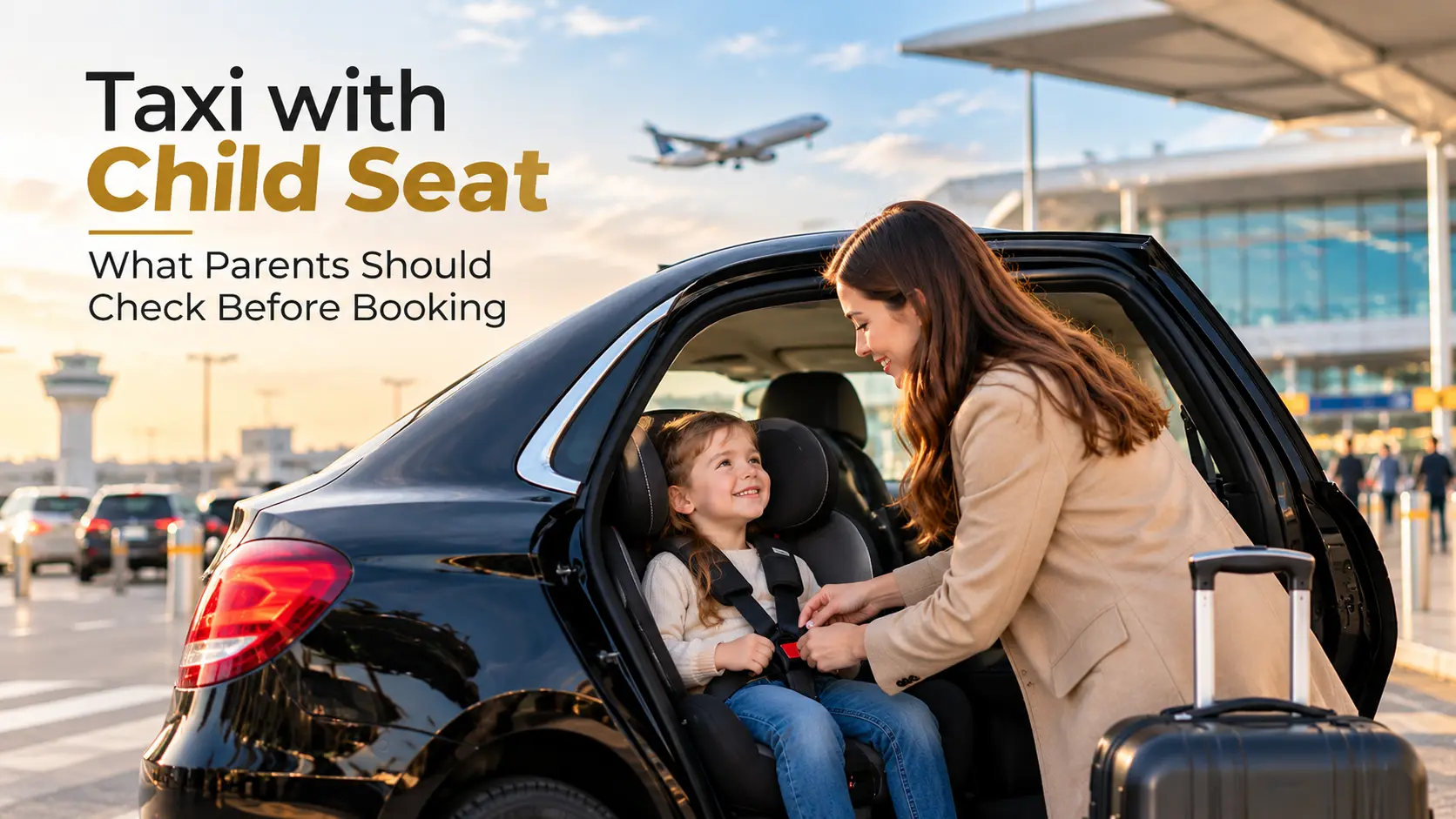
Travelling with children takes extra planning, especially when you need a suitable car seat for a taxi journey. Not every taxi company supplies baby seats or booster seats, so it is best to check before you book.
A taxi with child seat should have a restraint that suits your child’s size and can be fitted correctly in the vehicle. Before confirming your journey, check the seat type, availability, fitting arrangements and space for your family’s luggage.
This guide explains the UK rules, how to choose the right seat and what to ask the taxi operator. It also covers what to do if a suitable seat is not available.
Can You Request a Child Seat in a UK Taxi?
Yes, you can ask a taxi company for a child seat, but availability depends on the operator. Some companies may arrange an infant seat or booster seat, while others may ask you to bring your own.
Do not assume that a child seat will be available simply because you mentioned that you are travelling with children. Ask for the exact type you need and get confirmation before your pickup date.
What information should you provide?
Tell the operator your child’s age, height and weight, where relevant. Explain whether you need a baby seat, toddler seat or booster seat, and share the number of passengers and amount of luggage you will bring.
These details help the operator understand your child seat booking requirements and decide whether a larger vehicle may be more suitable.
When asking for a taxi with baby seat, explain that you are travelling with an infant rather than simply requesting a general child seat. A seat designed for an older child may not be suitable for a baby.
If the operator cannot confirm the correct seat, ask whether another vehicle is available or whether you can use your own compatible seat.
Which Child Seat Is Suitable for Your Child?
The right child seat depends on your child’s size and the manufacturer’s instructions. Age can help you narrow down the options, but you should not choose a seat based on age alone.
A seat must be suitable for your child and compatible with the vehicle in which it will be used.
Rear-facing baby seats
A rear-facing infant seat supports a baby during travel and is designed to protect the head, neck and body. If you need a seat for a newborn or young baby, confirm that the operator can arrange a suitable infant restraint.
Under the UK rules for height-based R129 seats, babies must travel rear-facing until they are over 15 months old. Manufacturers may recommend keeping a child rear-facing for longer, so follow the seat’s instructions.
Before your journey, check how the seat will be fitted. Some infant seats use a vehicle seat belt, while others need a compatible base or ISOFIX fittings.
Forward-facing seats for older children
A forward-facing child seat may be suitable once a child meets the requirements for that particular seat. The correct stage depends on the seat’s approval, the child’s measurements and the manufacturer’s guidance.
Do not assume that every toddler is ready to use a forward-facing seat. If the operator supplies the restraint, ask what type it is and whether it is suitable for your child.
Booster seats for older children
A booster seat helps position the adult seat belt correctly across a child’s body. The lap belt should sit low across the hips, while the diagonal belt should cross the shoulder rather than the neck.
When requesting a taxi with booster seat, give the operator your child’s height and ask what restraint it can provide. A booster cushion and a high-backed booster seat are not the same, so confirm the type before travelling.
You can read the official GOV.UK guidance on child car seats for more information about approved seats, age and height requirements.
What Are the UK Rules for Child Seats in Taxis?
UK child-seat rules normally require children to use a suitable child car seat until they reach 12 years old or 135 cm tall, whichever comes first. However, licensed taxis and private hire vehicles have a specific exemption when the driver has not provided the correct child seat.
According to GOV.UK guidance on when a child can travel without a car seat, the taxi and minicab exemption applies only when the child travels on a rear seat.
The rules for that situation are:
- Children under 3: If the correct child seat has not been provided, the child may travel on a rear seat without a seat belt.
- Children aged 3 or older: If the correct child seat has not been provided, the child may travel on a rear seat using an adult seat belt.
- Children who have reached 12 years or 135 cm: The usual child-seat requirement ends when either threshold is reached first. The child must use an adult seat belt where required.
These exemptions are legal exceptions, not the safest way to plan family travel. The Department for Transport says that the safest way for a child to travel by car is in an appropriate child seat. You can read its taxi and private hire vehicle licensing guidance.
If a suitable restraint is not available, consider asking for another vehicle or checking whether your own seat can be fitted correctly. Do not assume that every driver will agree to carry a child without a seat, even where a legal exemption exists.
What do R129 and ECE R44 mean?
The R129 child car seat standard is a height-based approval standard. Approved seats carry a label showing the letter “E” in a circle and the R129 marking.
The ECE R44 child car seat standard is a weight-based approval standard. Approved seats carry the relevant E-mark and ECE R44 marking.
These labels help you check whether a seat meets the relevant approval requirements. However, approval alone does not prove that a seat is right for your child or compatible with the taxi. You must also follow the manufacturer’s fitting instructions.
For the latest requirements, check GOV.UK’s child car-seat rules rather than relying only on information from taxi company websites.
What Should You Check Before Booking?
A few checks can prevent an unsuitable vehicle or an unexpected problem at pickup. Use this checklist before confirming your reservation.
Confirm the seat type and availability
Explain what you need and ask the operator to confirm that the correct seat will be available for your journey. If the company offers more than one type, check which one it plans to supply.
The main point is to confirm child seat availability rather than assuming your request has been accepted. A general note saying “travelling with a child” may not give the operator enough information.
If you are not sure which restraint your child needs, check the manufacturer’s guidance or ask a qualified child-seat fitting specialist before making your booking.
Check fitting arrangements
Ask whether the seat will be fitted by the driver or whether you need to install it yourself. If you are bringing your own seat, check whether the vehicle has the fittings it needs.
Seat belt compatibility matters because not every child seat can be installed in the same way. GOV.UK explains that a child car seat should only be used with a diagonal seat belt unless it is specifically designed for a lap belt or fitted using ISOFIX.
ISOFIX anchor points are fittings built into compatible vehicle seats. They allow compatible child seats to connect to the vehicle, but you must still follow the seat manufacturer’s instructions and check that the seat suits the vehicle.
Never assume that a seat will fit every car. If the driver cannot fit it as instructed, do not use it incorrectly just to complete the journey.
Check passenger numbers and luggage space
Think about everyone travelling, not just the child who needs the seat. A family may have two adults, two children, a pushchair and several suitcases, which can make a standard car less practical.
Tell the operator about your vehicle size and luggage space needs. Compare the available vehicles and luggage capacity before choosing an option that suits your passengers and bags.
Ask whether there will be enough space for the child seat, other passengers and luggage without blocking seats, seat belts or exits. Do not expect a larger vehicle to have a child seat unless the operator confirms it separately.
Get confirmation before pickup
Before the travel date, check that the booking details are correct. Confirm the pickup address, time, number of passengers and agreed seat type.
Keep the booking confirmation so you can refer to what was agree. If your requirements change—for example, another child joins the journey—tell the company as early as possible.
These steps make it easier to how to book a taxi with a child seat that meets your family’s needs: explain your requirements, check the arrangements and get confirmation before the journey.
Can You Bring Your Own Child Car Seat?
Yes, bringing your own seat may be a practical option if the taxi operator cannot supply a suitable restraint or if you prefer to use a seat you already know how to fit. You should still confirm that the vehicle can accommodate it.
If you plan to bring your own child car seat, check the following before travelling:
- The seat is approved and appropriate for your child’s size.
- It is not damaged and is used according to the manufacturer’s instructions.
- The taxi has compatible seat belts or the required ISOFIX fittings.
- The seat can be fitted correctly without blocking another passenger’s seat belt.
- The operator knows that you will bring the seat and has allowed enough room.
A personal seat is not automatically compatible with every vehicle. Some seats require a specific fitting method or additional components, such as a suitable base. If you are unsure, check the seat manual or contact its manufacturer before the journey.
Also consider how you will carry the seat when you reach your destination. A bulky seat may take up room in the boot, especially when travelling with a pushchair or several suitcases.
For child car seat safety, correct fitting is just as important as choosing a suitable seat. GOV.UK says you must deactivate any front airbag before fitting a rear-facing baby seat in a front passenger seat. Never fit a child car seat to a side-facing seat.
A rear seat is usually a practical choice in a taxi, but the seat must still be install correctly. Follow the manufacturer’s instructions and never improvise a fitting method.
What If the Requested Child Seat Is Not Available?
If the taxi arrives without the agreed seat, speak to the operator before setting off. Explain what was confirm and ask whether another suitable vehicle can be arrange.
Do not assume that an adult seat belt is an equal replacement for an appropriate child restraint. Although a limited taxi exemption exists in UK law, an appropriate, correctly fitted child seat remains the safer choice whenever possible.
If you know before pickup that the seat is unavailable, ask whether you can bring your own compatible seat or change the booking to a vehicle that meets your requirements. If neither option works, consider arranging alternative transport rather than making a rushed decision at the roadside.
When booking with Vine Taxis explain your child-seat needs in advance and ask the team to confirm what arrangements are available. Do not assume that a particular infant seat, toddler seat or booster will be supply unless the operator confirms it.
How to Plan an Airport Transfer with a Child Seat
An airport transfer with child seat needs the same restraint checks as any other taxi journey, but you may also have flight details, suitcases and a return pickup to arrange.
When booking, provide the pickup location, airport terminal, destination, passenger numbers and luggage details. State the exact child seat you need and ask for confirmation if possible.
Remember to arrange the return journey as well. A seat that is available for the outbound trip may not be available for the journey home, particularly if different operators or vehicles are involve.
Think about how much space your family needs. A pushchair, travel cot, baby bag and several suitcases may require a larger vehicle than the passenger count alone suggests. Ask the operator to confirm both passenger capacity and boot space before you book.
Leave enough time for loading luggage and settling your child into the seat. At the airport, check the collection point and any meeting instructions so you are not trying to sort out travel details while managing a tired child.
Confirm the same child-seat requirements for every part of your journey, including the trip home. This gives you time to make other arrangements if a suitable seat is unavailable.
Plan the Child Seat Before You Travel
A little planning can make a family taxi journey easier and help you avoid problems at pickup. Confirm the seat type, check that it suits your child, discuss fitting arrangements and allow enough room for passengers and luggage.
When arranging a taxi with child seat, prioritise a suitable, correctly fitted restraint rather than relying on the legal exemption. If a seat cannot be confirm, ask about another vehicle or whether you can use your own compatible seat before travelling.
Common Questions About Child Seats in Taxis
Do taxi companies have to provide child seats?
Taxi and private hire operators are not generally require to carry every type of child seat. Ask whether the operator can provide the right restraint and confirm the arrangement before travelling.
Will my own child car seat fit in every taxi?
No. Seats have different fitting requirements, and some need compatible ISOFIX points or a particular type of seat belt. Check the manufacturer’s instructions and the vehicle’s compatibility before travelling.
Should I confirm child-seat availability for the return journey?
Yes. Do not assume the return vehicle will have the same seat or fitting arrangements as the first one. Confirm the restraint and vehicle requirements for both journeys when you book.
How do you order a taxi with a child seat?
Book in advance and tell the operator your child’s age, height and weight. Ask for the exact seat you need and confirm its availability and fitting arrangements before travelling.
Can a 4-year-old go in a taxi without a car seat?
Under the UK taxi exemption, a 4-year-old may travel on a rear seat using an adult seat belt if the driver has not provided the correct child seat. A suitable child restraint remains the safer option whenever possible.
Can a taxi take 3 adults and 2 children?
Potentially, if the vehicle has enough licensed passenger seats and can accommodate the children safely. Tell the operator how many people are travelling, the children’s ages and how much luggage you will bring.