
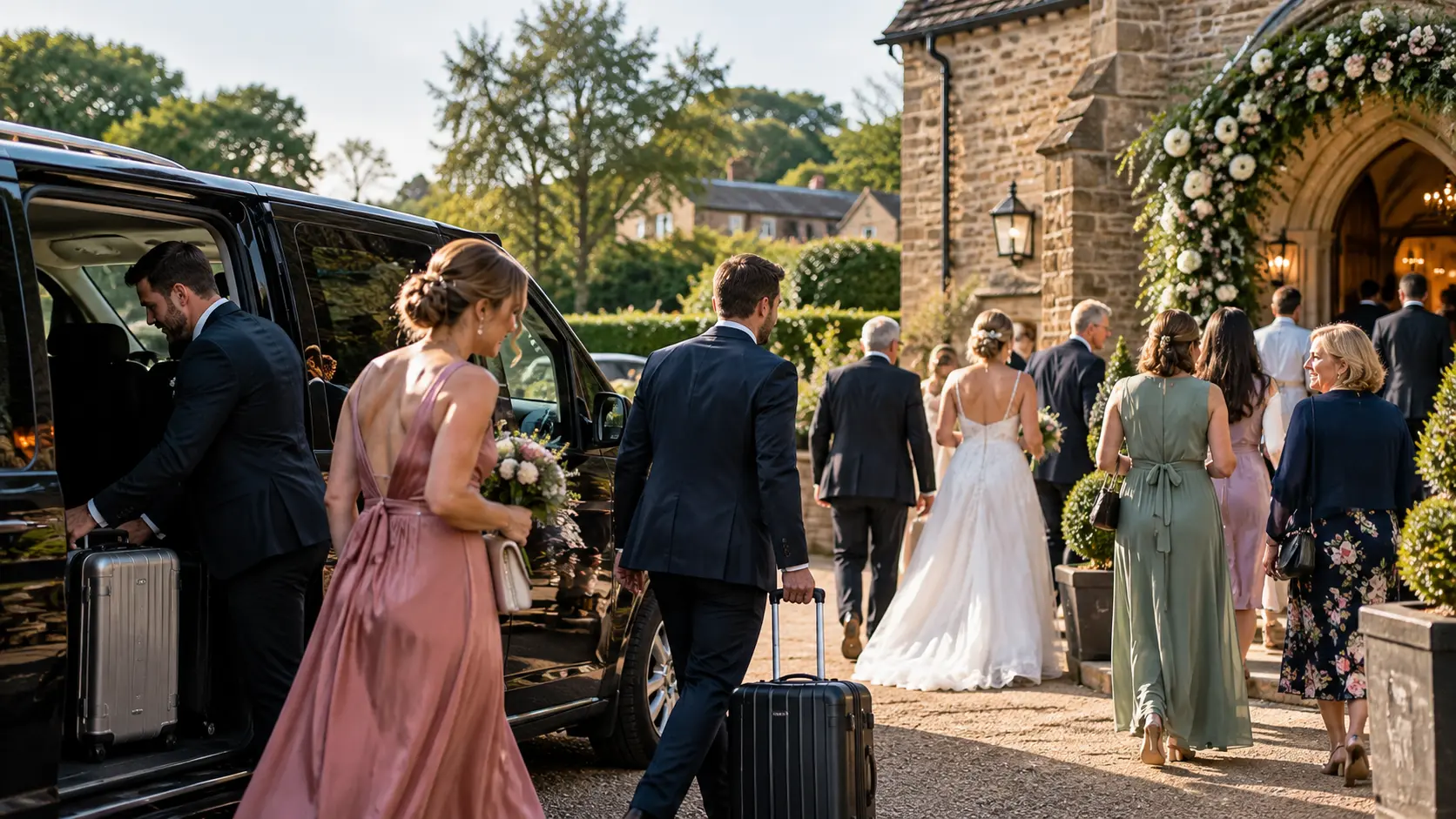
Getting wedding guests to the venue can look straightforward on the guest list, but the practical side is often more complicated. Some guests may live nearby, others may stay at hotels, and a few could arrive by train or plane. Then there is the return journey to think about once the reception finishes.
You do not need to arrange the same transport for everyone. A better approach is to look at who actually needs a ride, where they are starting, where they need to go and how they plan to get home.
Start With the Guests Who Need Transport
Not every wedding guest needs organised transportation. Some will drive themselves, some may stay close to the venue, and others may already have their own arrangements. The useful starting point is to identify the people who genuinely need help getting there or getting home.
Ask about transport as part of the RSVP process. A simple question about whether a guest needs transport to the venue, a return journey, or both can make the numbers much easier to work with. Grouping people by where they are staying can also reveal straightforward arrangements, such as several guests travelling together from the same hotel.
| Guest situation | Journey to consider |
| Local guest | Home → Venue |
| Hotel guest | Hotel → Venue |
| Train traveller | Station → Hotel or Venue |
| Airport traveller | Airport → Hotel or Venue |
| Family or friends travelling together | Shared taxi or larger vehicle |
| Guest staying overnight | Venue → Hotel |
The aim is to build a transport list that reflects your actual guests, rather than assuming everyone attending needs the same arrangement.
Do You Need a Shuttle, Coach or Taxi?
There is no universal answer. A coach or shuttle can work well when a large group is staying in the same place and travelling to the same venue at around the same time. Smaller groups often have more varied arrangements, making separate taxi journeys easier to organise.
Consider how your guests are spread out before choosing the transport.
| Your wedding situation | An option to consider |
| Many guests at one hotel | Coach or shuttle |
| Small family group | Taxi or larger taxi |
| Guests staying at different hotels | Separate journeys |
| Different return destinations | Individual group journeys |
| Guests arriving at different times | Separate taxis |
| Several venues during the day | Planned journeys between locations |
The question is not simply “How many guests are coming?” It is “How are those guests actually travelling?”
Choose the Vehicle Around Passengers and Luggage
A vehicle that fits the number of passengers may not always provide the space a group needs. Four guests travelling with overnight bags, suit carriers and personal belongings have different requirements from four people carrying almost nothing.
The same applies to larger groups. Six passengers travelling with wedding clothes and luggage may need more practical space than six passengers making a short local journey.
Vine Taxis has smaller cars alongside an MPV for around 5–6 passengers and a Mercedes Vito for around 7–8 passengers. Passenger numbers, luggage and the journey itself can all help determine which option is suitable.
Before arranging a journey, have these details ready:
- Number of passengers
- Approximate luggage requirements
- Pickup location
- Destination
- Date and travel time
That gives the transport provider a much clearer picture than passenger numbers alone.
Think Beyond the Main Wedding Venue
The wedding venue may be the main destination, but it is rarely the only place guests need to reach. A ceremony and reception may take place at different locations, while guests could be staying at several hotels nearby.
A guest’s day might look like:
Hotel → Ceremony → Reception → Hotel
Another guest might need:
Station → Ceremony → Home
Someone travelling from further away could have:
Airport → Hotel → Wedding Venue → Hotel
Mapping these journeys before the wedding makes it easier to see where organised transport is actually needed. It also prevents you from arranging a large group journey when only a smaller number of guests require it.
Don’t Forget Guests Arriving by Train or Plane
Some guests will begin their journey well before they reach the wedding area. A guest arriving by train may need transport from the station to their hotel, while someone flying in could need to continue from the airport to their accommodation or directly to the venue.
Common arrangements include:
- Airport → Hotel
- Airport → Wedding venue
- Railway station → Hotel
- Railway station → Wedding venue
- Wedding venue → Hotel
These journeys do not necessarily need to form part of the main wedding transport plan. They can be arranged around the guest’s own arrival time.
For airport arrivals, an airport transfer service can form part of the wider travel plan. The important thing is to give guests clear instructions before the wedding, particularly when they are unfamiliar with the area.
Make the Pickup Point Easy to Understand
A transport plan can be perfectly organised and still cause confusion when guests do not know where to meet their vehicle. “Your taxi will collect you from the hotel at 5pm” may leave someone wondering which entrance to use.
Give guests the practical details they need:
- Hotel or venue name
- Pickup time
- Exact meeting point
- Destination
- Who they are travelling with
- Contact details for the person coordinating transport
This becomes particularly useful at larger hotels and wedding venues with multiple entrances or access points. Keep the information somewhere guests can find it easily, such as the wedding website or a final guest information message.
Plan the Journey Home Before the Reception
Getting guests to the wedding is only half the job. Once the reception ends, people may be travelling to different hotels, homes or towns. Some guests may leave earlier because of children or other commitments, while others may stay until the end of the evening.
Think about the return journey while arranging the outward journey.
A simple plan could look like:
Hotel A → Venue → Hotel A
Home Group → Venue → Home Group
Hotel B → Venue → Railway Station
You do not have to make every guest leave at the same time. The important part is knowing how each group will get home before the evening begins.
When the Ceremony and Reception Are in Different Places
Separate ceremony and reception venues add another part to the transport plan. Guests may need to travel from a church, registry office or other ceremony location to the reception venue, sometimes with little time between the two. Start by identifying which guests need help making that connection.
| Part of the day | What to check |
| Before ceremony | Who needs transport to the first venue? |
| After ceremony | Who needs to travel to the reception? |
| Reception | Where is each group staying? |
| End of evening | How will each group get home? |
This keeps the plan focused on actual journeys rather than adding transport simply because it is a wedding.
A Simple Wedding Guest Transport Checklist
Before confirming everything, work through the essentials:
Guest details
- Who needs transport?
- Which guests are travelling together?
- Where are they staying?
Journey details
- Where is each group being collected?
- Where do they need to go?
- Are there separate ceremony and reception locations?
Vehicle details
- How many passengers are travelling?
- How much luggage will they have?
- Does any group need a larger vehicle?
Return details
- Where is everyone going afterwards?
- Will different groups need different journeys?
- Who will answer transport questions on the day?
This small checklist can uncover gaps before the wedding day rather than during it.
Wedding Guest Travel Around Sevenoaks and Kent
For weddings around Sevenoaks and surrounding Kent, guests may arrive from several directions. Family could be travelling from Tonbridge, friends may be staying in Tunbridge Wells, and other guests may be coming from further away.
That can make one central pickup point impractical for smaller groups. The same planning principle applies across the area: group guests with similar journeys, consider their luggage and make the return arrangements clear before the wedding day. Vine Taxis is the part of that wider plan for guests travelling around Sevenoaks, Tonbridge, Hildenborough and surrounding areas.
Plan the Journey, Not Just the Arrival
Wedding guest transportation becomes much easier when you stop treating the guest list as one large group. Work out who needs a ride, where each group is starting, what they are carrying and where they need to go afterwards. From there, choosing between a taxi, larger vehicle or shuttle becomes much more straightforward.
For many weddings, the simplest transport plan is the one built around the way guests actually travel — not the one that tries to put everyone into the same vehicle.
Frequently Asked Questions
How do you transport wedding guests to and from a venue?
Group guests by their pickup location, passenger numbers and destination, then arrange suitable transport for each group.
Should wedding guests have transport home?
It is worth planning a return option, especially for guests who cannot easily drive or use public transport after the reception.
Is a taxi suitable for a small wedding group?
Yes. A taxi or larger vehicle can work well when a small group is travelling together, particularly from the same hotel or location.
Can wedding guests travel from an airport or railway station?
Yes. Guests can arrange a taxi from an airport or station to their hotel, wedding venue or another planned destination.
Do wedding guests need to travel in one vehicle?
No. Smaller groups can travel separately when guests have different pickup points, timings or destinations.