
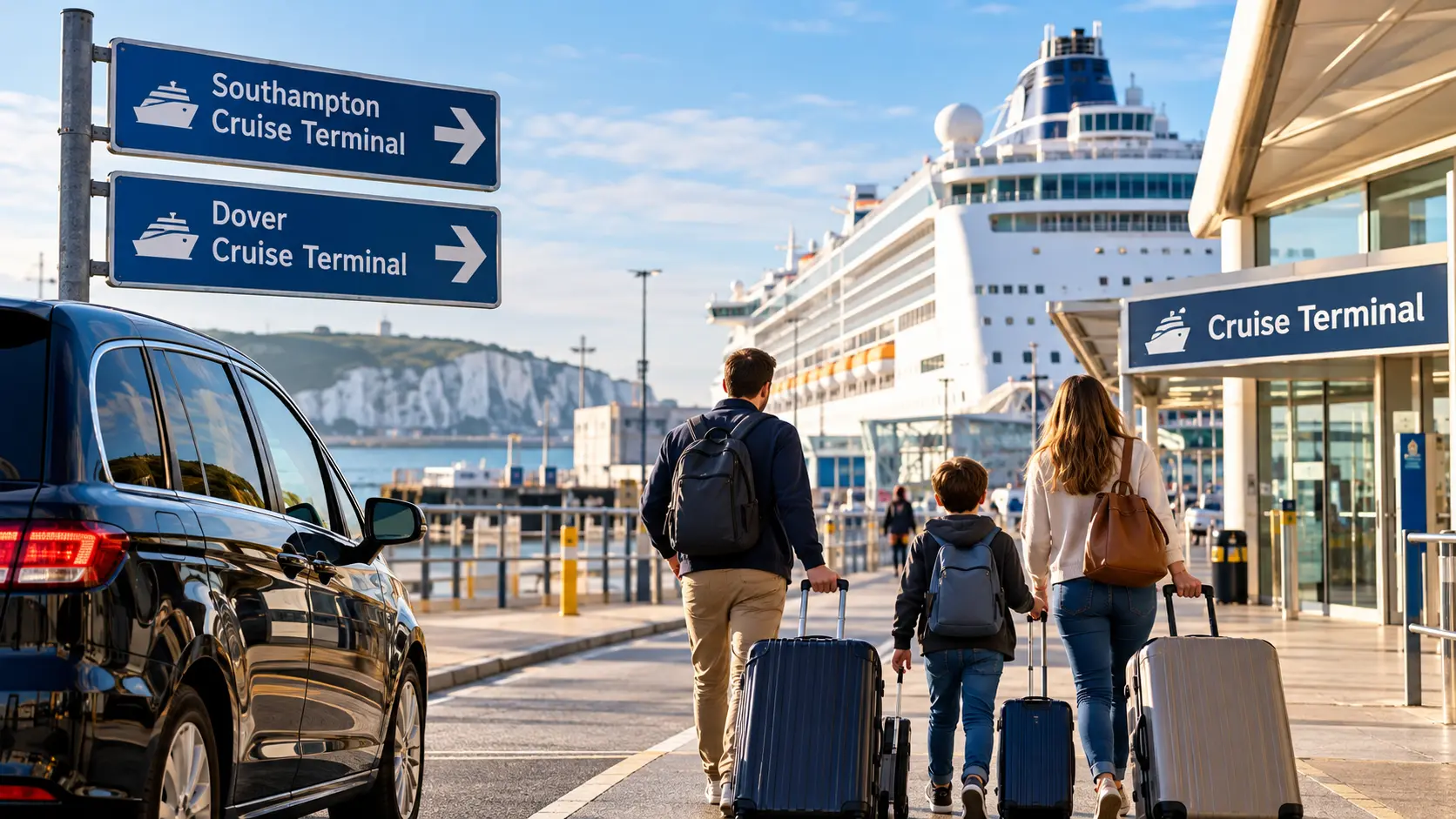
A cruise holiday often starts with an early departure, several suitcases and a journey that needs to run to schedule. If you are travelling from Kent, a little preparation can help you choose the right transport to reach the correct terminal and avoid rushing on the day.
The best option depends on where you are starting, how far you need to travel and whether you prefer to drive, take the train or arrange a direct transfer. Each option has advantages, but the details matter: a convenient train route may involve an extra connection, while a taxi journey requires you to plan around traffic and luggage space.
1. Check Which Cruise Terminal Your Ship Uses
Before planning the route, check your cruise confirmation for the port and terminal assigned to your ship. Large ports can operate several terminals, and the correct drop-off point may affect your final route.
Southampton cruise terminals
Southampton has five main cruise terminals across its Eastern and Western Docks.
| Terminal | Dock area |
| Ocean Cruise Terminal | Eastern Docks |
| Queen Elizabeth II (QEII) Terminal | Eastern Docks |
| City Cruise Terminal | Western Docks |
| Mayflower Cruise Terminal | Western Docks |
| Horizon Cruise Terminal | Western Docks |
Use the terminal details supplied by your cruise operator rather than choosing one based on the port name alone. Check the latest directions and passenger drop-off instructions before travelling, as access arrangements may vary.
Travelling to Dover Cruise Terminal
Dover handles both cruise and ferry traffic, so make sure you have the correct destination before setting off. A general search for Dover Port may not provide the specific drop-off information you need.
Check your cruise documents for the terminal or passenger entrance and use those details when planning your route. This is particularly important if you are arranging a taxi to Dover Cruise Terminal or asking someone to drive you there.
2. Compare Your Transport Options
The most suitable way to reach the port depends on your starting point, budget, luggage and available connections. Compare the whole journey rather than looking only at the main travel fare.
| Option | What makes it useful | What to consider |
| Train | Can be convenient when rail connections suit your route | Changes, station access and the final journey to the terminal |
| Pre-booked taxi | Offers a direct journey from an agreed pickup point | Fare, traffic, vehicle capacity and pickup arrangements |
| Train and taxi | Combines rail travel with a shorter road journey | Connection times and handling luggage between services |
| Driving | Gives you control over your departure time | Port parking, parking costs and the length of your trip |
| Staying overnight near the port | Reduces the distance you need to travel on departure day | Accommodation costs and transport to the terminal the next morning |
A taxi to a cruise terminal may suit passengers carrying several suitcases, travelling with children or starting from somewhere with inconvenient public transport connections. Rail travel may be a better fit if you have a straightforward route and want to avoid the cost of a longer private journey.
To compare the options fairly, include the cost of getting to and from stations, any onward taxi fares, parking charges and the time needed to manage your luggage.
3. Work Backwards from Your Required Arrival Time
Your cruise operator’s check-in instructions should determine when you need to reach the port. Once you know that time, work backwards to estimate when you should leave.
For example, if you need to arrive by noon and your route planner estimates a two-hour drive, leaving at 10 am would leave no allowance for traffic or other delays. You would need to leave earlier and choose a contingency that reflects the route and conditions.
When planning the journey, consider:
- Traffic and roadworks: Check conditions around your expected departure time, not just the quickest route shown online.
- Distance from your pickup point: Journey times can differ considerably between towns and rural locations across Kent.
- Time of day: Early starts, weekends and busy holiday periods may affect road conditions.
- Check-in instructions: Follow the arrival window supplied by your cruise operator rather than assuming that arriving just before departure will be sufficient.
- Unexpected delays: Allow additional time for disruption, particularly if missing the check-in window would affect your holiday.
For train journeys, apply the same approach to connections. Check the complete route, including the journey to the first station and the final leg to the port.
4. Plan for Your Luggage Before Choosing Transport
Cruise luggage can take up more space than a typical day trip. Several large suitcases, cabin bags, pushchairs or mobility equipment may affect which transport option works best.
If you plan to travel by taxi, tell the provider how many people are travelling and how much luggage you expect to bring. Passenger capacity alone does not tell you whether every bag will fit.
For train travel, consider how easily you can move your luggage between platforms and connections. If you are driving, check whether you can fit everything comfortably in your vehicle and whether your parking arrangements suit the size of your car.
Families should also account for child seats and pushchairs. Passengers who need extra assistance should consider walking distances, vehicle access and the arrangements available at each end of the journey.
Planning these details early helps you avoid last-minute changes or discovering that your chosen transport cannot accommodate everyone comfortably.
5. Should You Travel on the Day or Stay Overnight?
Travelling to the port on departure day may be practical when your route is manageable and your check-in time allows enough flexibility. For longer journeys, staying near the port the previous night may reduce the amount of travel you need to complete on sailing day.
| Consideration | Travel on departure day | Stay overnight |
| Accommodation | No extra hotel night | Adds accommodation costs |
| Journey timing | Requires careful planning on sailing day | Splits the journey into two stages |
| Traffic disruption | Delays may affect your arrival that day | Reduces the distance to cover on departure day if you stay nearby |
| Best fit | Manageable journeys with a suitable arrival window | Longer journeys or early check-in times |
Compare the total cost of each option, including accommodation, meals, parking and onward transport. Staying overnight does not remove every risk, but it may make the morning of departure easier to manage.
6. A Practical Checklist for Cruise Travel
Once you have chosen your transport, use this checklist to check the details before departure.
- Confirm the cruise port and assigned terminal.
- Check the required arrival time and embarkation instructions.
- Plan the complete route from your actual starting address.
- Allow time for traffic, connections and unexpected delays.
- Check luggage space and any special travel requirements.
- Confirm the pickup time, fare and arrangements if using a taxi.
- Save your cruise documents and terminal directions where you can access them easily.
- Make a separate plan for your return journey if needed.
Booking a private transfer, confirm what the fare includes and how the provider handles changes to the booking. Do not assume that a return journey is included in a one-way arrangement.
Final Thoughts
A well-planned journey starts with the right information: the correct terminal, a realistic travel schedule and transport that suits your passengers and luggage. Comparing the full journey also helps you make a more informed decision about cost and convenience.
Before you leave, check your cruise operator’s latest instructions and review your route. If you are considering a private taxi, make sure the provider accepts your destination and has confirmed the arrangements for your travel date.
Frequently Asked Questions
How do I find the correct cruise terminal?
Check your cruise confirmation for the assigned terminal and drop-off instructions.
Is a taxi or train better for reaching a cruise port?
A taxi offers a direct journey, while a train may be cheaper if connections are convenient. Compare the full journey and luggage requirements.
How early should I leave for the cruise terminal?
Follow your cruise operator’s arrival instructions and allow extra time for traffic or delays.
What should I check when booking a taxi to Dover Cruise Terminal?
Confirm the terminal, pickup time, passenger numbers, luggage space and fare.
Should I stay overnight near Southampton?
Consider an overnight stay if you have a long journey or an early check-in time. Compare accommodation costs with same-day travel.
Should I book my return transfer in advance?
If possible, confirm your return pickup point and timing before your cruise ends.